


About The Department
The department of Microbiology was started in the year 2016 with objectives of promoting quality and values based education by motivating the practical skills of students and create awareness on the recent advances in Microbiology and research fields worldwide. The department offers core subjects on the general microbiology, microbial diversity, agricultural microbiology, environmental microbiology, industrial microbiology, food microbiology, immunology, medical microbiology, microbial genetics, fermentation technology and plant pathology.
The department of Microbiology comprises of the Microbiology Lab, Immunology Lab, Biotechnology Lab, Biochemistry techniques lab and fermentor room. The thrust areas of research are the use of molecular methods in diagnosis and drug resistance in bacterial, fungal, viral, and parasitic infections and the use of Nanotechnology in the field of antimicrobials. The students of the Microbiology Department are a vibrant group, enthusiastically organizing and participating in various activities of the Department such as Annual Sports Day, Monthly Journal Club, Monthly Work presentations, and Field Trips.
Head of the Department

Dr. S. GANESH KUMAR, M.Sc., M.Phil., Ph.D., Postdoc.,
Associate Professor & Head
Department of Microbiology
Members of Board of Studies
S. No | Name | Designation | Member |
1. | Dr. S. Ganesh Kumar | Associate Professor & Head, SPIHER | Chairman |
2. | Dr. N. Gunavathy | Assistant professor, SPIHER | Internal Member |
3. | Mrs. A. Nelofer | Assistant professor, SPIHER | Internal Member |
4. | Mrs. M. Dhivya | Assistant professor, SPIHER | Internal Member |
5. | Dr. D. Saravanan | Assistant professor, Department of BiochemistryD.G. vaishnav College, Arumbakkam, Chennai-600106 | External Member |
6. | Dr. S. Jamuna | Director, Affyclone Laboratories Pvt LtdChrompet, Chennai-600044 | External Member |
7. | Ms. R. Muthulakshmi | Executive Microbiologist,Food Biosciences Laboratory, Madipakkam, Chennai-600091 | Alumni-member |
B.Sc. – Microbiology
A Candidate who has passed the Higher Secondary Examination with Biology as the main subject of study or equivalent thereto is eligible for admission to three years B.Sc Programme in Microbiology. This is a three-year programme comprising 6 semesters. Each semester has a minimum of 90 working days. The languages offered are Tamil, French, Hindi and Telugu. The curriculum is enriched with the latest topics of fundamentals of Microbiology, Non-major elective subjects and soft skills are added with reasonable credits. Equal importance is given to the practical classes. Biochemistry and Biostatistics are offered as allied subjects in the I year and II year, respectively. Various aspects of Microbiology subjects like Food and Dairy Microbiology, Environmental Microbiology and Medical Microbiology are also included in the final year.
Curriculam and Syllabus
M.Sc. – Microbiology
A candidate who has passed the B. Sc (Microbiology) degree examination of this University or the examination of another University accepted as equivalent subjects such as Biotechnology, Biology and Food Science etc., thereto are eligible for admission to two year M.Sc Programme in Microbiology. This Programme comprises 4 semesters. Each semester has a minimum of 90 working days. The programme consists of theory papers along with laboratory including Institute Core Courses, Institute Elective Courses, Program Core Courses and Program Elective Courses. Further Research Project and Internship in the curriculum helps to gain hands-on research experience for the students apart from improving practical skills for employability. Furthermore, the project work gives them access to handle sophisticated instruments that would be able to conduct high-quality research in their future endeavors. The M. Sc programme comprises four semesters with 90 Credits
Curriculam and Syllabus
Ph.D – Microbiology
Doctoral study in Microbiology prepares students for research and teaching careers with diverse emphases in the various aspects of Microbiology.
Activities
Vision & Mission
Vision
To emerge as a dynamic centre of excellence in Microbiology and to flourish in both national and international scene.
Mission
- To conduct high quality research in Microbiology
- To effectively transform our theoretical knowledge and practical skills in Microbiology to the industry and to the common public.
- To impart technical skills with integrity and ethical standards in students.
PROGRAMME EDUCATIONAL OBJECTIVES (PEOs):
- PEO-1: Introduce advanced techniques and ideas required in developing area of Microbiology
- PEO-2: Enhance the students’ ability to develop interdisciplinary knowledge.
- PEO-3: Gain the knowledge of Microbiology through theory and practical
- PEO-4: Understand and apply the knowledge of Microbiology for understanding the scientific phenomenon in the aspects of Microbiology
- PEO-5: Understand and apply analytical techniques for evaluating the various biochemical systems.
- PEO-6: Understand good laboratory practices (GLP) and biosafety.
- PEO-7: Develop research oriented skills.
- PEO-8: Make aware and handle the sophisticated instruments/equipment's.
PROGRAMME OUTCOMES (POs):
- PO1 Critical Thinking: Take informed actions after identifying the assumptions that frame our thinking and actions, checking out the degree to which these assumptions are accurate and valid, and looking at our ideas and decisions (intellectual, organizational, and personal) from different perspectives.
- PO2 Effective Communication: Speak, read, write and listen clearly in person and through electronic media in English and in one Indian language, and make meaning of the world by connecting people, ideas, books, media and technology.
- PO3 Social Interaction: Elicit views of others, mediate disagreements and help reach conclusions in group settings.
- PO4 Effective Citizenship: Demonstrate empathetic social concern and equity centred national development, and the ability to act with an informed awareness of issues and participate in civic life through volunteering.
- PO5 Ethics: Recognize different value systems including your own, understand the moral dimensions of your decisions, and accept responsibility for them.
- PO6 Environment and Sustainability: Understand the issues of environmental contexts and sustainable development.
- PO7 Self-directed and Life-long Learning: Acquire the ability to engage in independent and life-long learning in the broadest context socio-technological changes
- PO8 Modern tool usage: Create, select, and apply appropriate techniques, resources, and modern engineering and IT tools including prediction and modelling to complex engineering activities with an understanding of the limitations.
PROGRAM SPECIFIC OUTCOMES (PSOs):
- PSO-1: Ability to understand the concepts and applications in the field of advanced techniques and ideas required in developing area of Microbiology
- PSO-2: Ability to understand the scientific phenomenon in microbial enzymes, metabolism and proteins
- PSO-3: Ability to apply the learning from the courses and develop applications for real world research problems..
Events
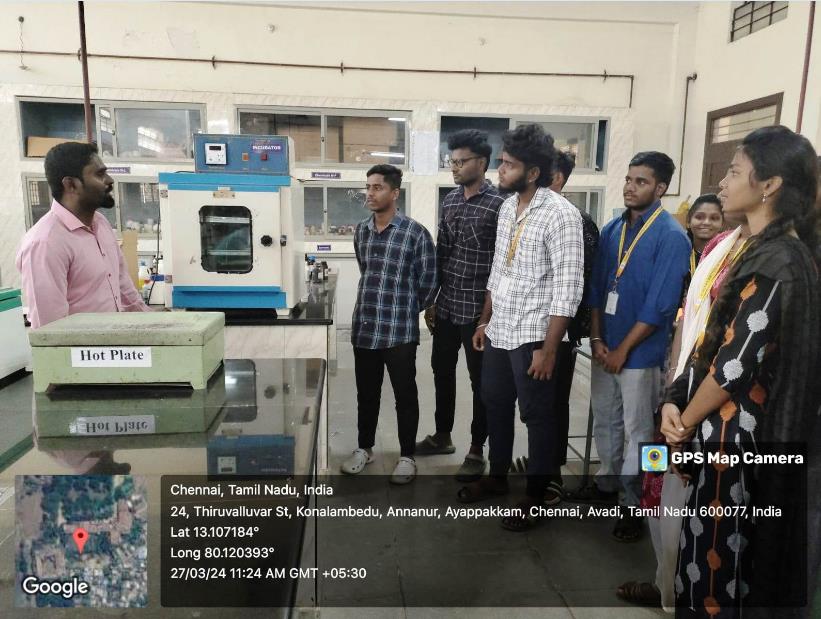
How to plan for Start-Up and Legal & Ethical steps on March 27, 2024
Demonstration of basic instrumentation in laboratory” on March 11, 2024


Fundamentals of fermentation process development” on March 05th 2024
Recent techniques on Biosciences” on February 01, 2024


Women’s Health Awareness programme for Female School students” at Kolappancheri Government School on October 27th 2023
Awareness Program on
Wildlife welfare” at
Kolappancheri village on October 27th 2023

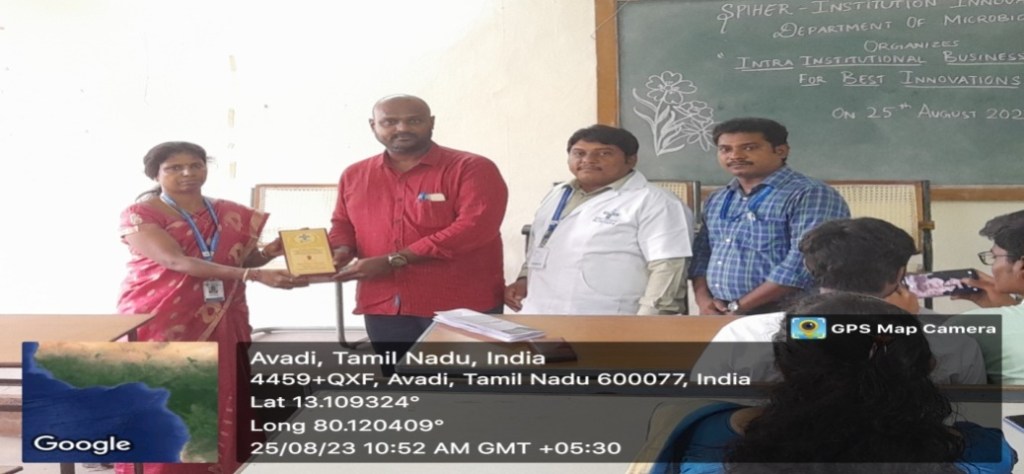
Intra Institutional Business Plan Competition for The Best Innovations” on August 25, 2023