


About The Department
The Department of Mechanical Engineering was established at the time of inception of the Institution in 1993. The Department offers U.G., P.G. and Research programmes which are certified by National Board of Accreditation.
The 4-year professional undergraduate Mechanical Engineering program provides an intellectual foundation in wide streams such as Design, Energy, Industrial, Manufacturing, Thermal, Automation, Automotive and Materials and prepare the students for the careers in Engineering, Technology, Management and Entrepreneurship. The program is designed to cater to the needs of students to acquire inter-disciplinary and multi-disciplinary skills.
The department facilitates with necessary infrastructure of Basic Workshop laboratory, Dynamics Laboratory, Thermal Engineering Laboratory, CAD Laboratory, Machine Shop, and Metrology Laboratory. The department has well trained senior faculty members guiding the students through their technical education and helping them in developing innovative projects. The department nurtures the skill and capacity through enhancement programme so as to make them to meet the challenges of rapid competitive job market.
The students have got very good opportunities to clutch job in Manufacturing, Service, Production Planning, Quality, Inspection, Maintenance, Safety, Sales, Research & Development activities of various organizations in core and multidisciplinary domain in National and International firms and organizations. The Mechanical Engineering graduates have a very wide scope for pursuing higher education across the globe in the recent demanding streams like Automation, Robotics, Control Systems, Advanced Engineering Materials, Smart Manufacturing Technology, Business Administration etc.
Head of the Department
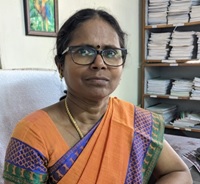
Dr. N. RAJESWARI, M.E., Ph.D.
Professor & Head,
Department of Mechanical Engineering
Members of Board of Studies
| S.No | Name | Designation | Member |
| 1 | Dr. N. Rajeswari | Professor & Head | Internal Member |
| 2 | Dr. P. Periyasamy | Professor | Internal Member |
| 3 | Dr.D.Chandramohan | Professor | Internal Member |
| 4 | Dr. K. Gurusami | Associate Professor | Internal Member |
| 5 | Dr. M. Dhanashekar | Assistant Professor | Internal Member |
| 6 | Dr. S. Dinesh Kumar | Assistant Professor | Internal Member |
| 7 | Mrs. K. Sunitha | Assistant Professor | Internal Member |
| 8 | Mr. S. Rangarajan | Assistant Professor | Internal Member |
| 9 | Dr. A. Elaya Perumal | Professor & Head, Engineering Design Division, Anna University, Chennai | External Member |
| 10 | Mr. A. Mahibalan | Scientist, C.V.R.D.E. (DRDO) Chennai. | External Member |
B.E. – Mechanical Engineering
B.E. - Mechanical Engineering
The Department of Mechanical Engineering is currently the best destination for the dream of the students with highly qualified faculty and the state of art laboratories. It is one of the established and largest departments in the institution. The department aims at creating quality engineers with sound technical knowledge and awareness of the latest advancements in existing and emerging technologies.In all courses the department has built an excellent reputation for its graduates in terms of placements.
Our faculty brings state-of-the-art research, development, and design experience into the classroom, ensuring that our students and alumni are able to apply for registration as professional engineers in all part of global engineering and the scientific community. The faculty and students of Mechanical are continuously engaged in the relentless endeavor to improve upon past performance and to uplift the position among the league of engineering institutions. Seminars, Conferences, Project Expo, and symposia were organized by the department for initiating research in young minds. Students were encouraged by giving seed money for the best ideas do their project.
The Mechanical Engineering has always enjoyed a respectable status among the major recruiters in India and the excellent performance of its students across the industry has enabled the department to maintain its strong brand image.
Curriculum and Syllabus
M.E. – Advanced Manufacturing Technology
This programme has been framed to provide students with an understanding of specific advanced body of knowledge and emerging manufacturing technologies and skills relating to the application and implementation of the advanced technologies in modern industry within both global and local contexts. It is expected that the graduates from this course will be sufficiently competent to direct the design, development and implementation of specific technologies and/or processes addressed during the course in the context of a particular organisation.
Career opportunities
The course offers the opportunity for employment with manufacturing companies intending to implement different levels of advanced manufacturing technologies. Graduates may find employment as design engineers, manufacturing engineers, production engineers, engineering managers, systems engineers, or research and development engineers in companies such as automotive, appliances manufacturing and discrete manufacturing intending to adopt advanced manufacturing technologies to enhance the productivity and competitive advantage in the global market.
Aims and objectives
At the completion of the Master of Engineering Science (Advanced Manufacturing Technology) course, graduates will be able to:
- Demonstrate high-level advanced knowledge and skills in advanced design and manufacturing practice.
- Plan and implement an independent research project in advanced manufacturing technology applying research principles and methods and using technical research skills.
- Reflect on contemporary and emerging issues and trends in advanced manufacturing technology practice.
- Investigate, analyses and synthesize complex information, problems, concepts and theories from advanced manufacturing practice to provide solutions to complex problems using critical thinking and independent judgment.
- Demonstrate clear and coherent communication skills to articulate complex knowledge and justify propositions and professional decisions in advanced manufacturing to specialist and non-specialist audiences.
- Demonstrate a high level of autonomy, accountability, credibility, ethics, and responsibility for all personal work outputs in the advanced manufacturing sector.
Curriculum and Syllabus
Ph.D. – Mechanical Engineering
Activities
MOU

Department of Mechanical Engineering has signed MOUs with the following concerns:
- MOU has been signed with i3 DESIGN TECHNOLOGIES, on 12th June 2015 for the benefits of students and Research Scholars with the collaboration of Research and Development Units.
- MOU has been signed with ZYBEAK TECHNOLOGIES on 2ndAugust 2015 for the benefits of students and Research Scholars.
- MOU has been signed with ?WITY SOLUTIONS on 2ndAugust 2016 for the benefits of engineering graduates and Research Scholars with the collaboration of Research and Development Units
- MOU has been signed with SYNCE ENGINEERING Pvt Ltd. Technologies on 2ndAugust 2016 for the benefits of students and Research Scholars with the collaboration of Research and Development Units.
- MOU has been signed with SP INSTITUTE CNC TRAINING CENTRE on 23rdAugust 2017 for the benefits of students with the collaboration of Research and Development Units.
Facilities
Infrastructures: Lab Facilities
| S.No | Name of the course | Name of the Laboratory/Workshop | Total Area of the Lab./ Workshop (Area in Sq.m) |
| 1 | B.E. (Mech.Engg.) | Basic Workshop | 468.2 |
| 2 | B.E. (Mech. Engg.) | Computer Aided Design | 240 |
| 3 | B.E. (Mech. Engg.) | Dynamics | 240 |
| 4 | B.E. (Mech. Engg.) | Thermal Engineering & Heat Transfer | 491.2 |
| 5 | B.E. (Mech. Engg.) | Metrology & Measurements | 208 |
| 6 | B.E. (Mech. Engg.) | Manufacturing Technology | 769 |
Research Facilities
In addition to conventional machineries, the department is equipped with Advanced and Robust machineries of Rapid prototyping, Computer Numerical Control machine tools and Co-ordinate Measuring Machine, to enable research activities.
Department Library
Department library is furnished with exhaustive collection of both text and reference books of various Mechanical Engineering streams.
| S.No | Particulars | No. Available |
| 1 | Books | 1109 |
| 2 | Student Project Reports | 550 |
| 3 | Question Bank | 59 |
| 4 | Student Project CDs | 178 |
Vision & Mission
VISION
To emerge as dynamic center for quality education and research, dedicated to produce outstanding Mechanical Engineers through strong theoretical knowledge and practical training.
MISSION
M1: Contemporary and effective educational experiences that develop the competent engineers.
M2: Achieving intellectual excellence by providing facilities for students for higher education and research.
M3: To inculcate technical skills with integrity and ethical standards in students.
M4: To impart entrepreneurship qualities to indulge in promoting sustainable development of the society.
PROGRAMME EDUCATIONAL OBJECTIVES:
PEO 1. Build a successful career in Mechanical Engineering and allied industries.
PEO 2. Be expertise in the areas of Design, Thermal, Materials and Manufacturing.
PEO 3. Contribute towards technological development through academic research and industrial practices.
PEO 4. Practice their profession with good communication, leadership, ethics and social responsibility.
PEO 5. Graduates will be competent to adapt to evolving technologies through life-long learning.
| PROGRAM OUTCOME (PO)
(to be achieved by the graduate after 4 to 5 years of graduation) |
|
| Graduate Attributes (NBA): All graduates of any higher education programs are expected to have identified technical/ functional, generic and managerial competencies. The competencies that a graduate of a program should have are called Graduate Attributes. The Attributes a graduating engineer should have are generally identified by the Accreditation agency for Engineering and Technical Education, namely, National Board of Accreditation (NBA) in India. The Graduate Attributes of Engineering Programs as identified by NBA are | |
| 1 | Engineering knowledge: Apply the knowledge of mathematics, science, engineering fundamentals, and an engineering specialization to the solution of complex engineering problems. |
| 2 | Problem analysis: Identify, formulate, research literature, and analyze complex engineering problems reaching substantiated conclusions using first principles of mathematics, natural sciences, and engineering sciences. |
| 3 | Design/development of solutions: Design solutions for complex engineering problems and design system components or processes that meet the specified needs with appropriate consideration for the public health and safety, and the cultural, societal, and environmental considerations. |
| 4 | Conduct investigations of complex problems: Use research-based knowledge and research methods including design of experiments, analysis and interpretation of data, and synthesis of the information to provide valid conclusions. |
| 5 | Modern tool usage: Create, select, and apply appropriate techniques, resources, and modern engineering and IT tools including prediction and modeling to complex engineering activities with an understanding of the limitations. |
| 6 | The engineer and society: Apply reasoning informed by the contextual knowledge to assess societal, health, safety, legal and cultural issues and the consequent responsibilities relevant to the professional engineering practice. |
| 7 | Environment and sustainability: Understand the impact of the professional engineering solutions in societal and environmental contexts, and demonstrate the knowledge of, and need for sustainable development. |
| 8 | Ethics: Apply ethical principles and commit to professional ethics and responsibilities and norms of the engineering practice. |
| 9 | Individual and team work: Function effectively as an individual, and as a member or leader in diverse teams, and in multidisciplinary settings. |
| 10 | Communication: Communicate effectively on complex engineering activities with the engineering community and with society at large, such as, being able to comprehend and write effective reports and design documentation, make effective presentations, and give and receive clear instructions. |
| 11 | Project management and finance: Demonstrate knowledge and understanding of the engineering and management principles and apply these to ones own work, as a member and leader in a team, to manage projects and in multidisciplinary environments. |
| 12 | Life-long learning: Recognize the need for, and have the preparation and ability to engage in independent and life-long learning in the broadest context of technological change. |
PROGRAMME SPECIFIC OUTCOMES (PSOs):
PSO 1. Apply the principles of Mechanical Engineering to Model, Analyze, Design and realize the cause and effects on machine elements, physical components, processes and systems.
PSO 2. Work professionally in the Mechanical Systems.
PSO 3. Ability to apply the acquired Mechanical Engineering knowledge for the advancement of individual and society.