


About The Department
Department of Economics - under the School of Arts Science and Humanities - is a humble beginning in the year 2016 to impart quality education in economics and to promote Higher Education and Research that seeks to provide policy solutions for economic problems faced by the country. The department has adequate faculty members with different specializations. Also, it invites Professors of national repute to take classes and share their expertise. The department offers many emerging, research oriented, mathematical and econometrics based elective courses in BA and MA Economics. To equip the students with research skills and prepare them for various avenues of employment, the department provides research methodology and dissertation courses. As a leading teaching and research institute in India, the department holds field surveys, seminars, conferences, symposiums, panel discussions and interactive sessions regularly in the areas of Rural Water Supply, Tribal Economics, Development Economics, Industrial Economics, Rural Economics, Environmental Economics, Agricultural Economics, Tourism Economics, Studies on Women Empowerment through Self-Help Groups and so on.
Head of the Department

The minimum and maximum period for the completion of the Undergraduate degree with multiple entry and exit option are given below.
| Programme | Year of Study | Minimum No. of Semesters |
| BA Economics | I | 2 |
| II | 4 | |
| III | 6 | |
| IV | 8 | |
| MA Economics | I | 2 |
| II | 2 |
Each semester normally consists of 90 working days or 450 hours instructional hours of study. Examination shall be conducted at the end of every semester for the respective course.
B.A. – Economics
B.A. Economics – I Year –2023-24 Regulations (B.A. Honors – 8 Semesters)
B.A. Economics – II Year – 2023-24 Regulations (B.A. Honors – 8 Semesters)
B.A. Economics – III Year - 2020 Regulations
M.A. – Economics
M.A. Economics – I Year – 2020 Regulations
M.A. Economics – II Year – 2020 Regulations
Ph.D. – Economics
Activities
Research Activities
Research Activities have been planned and will be initiated only from the academic year 2024-25, since the full course of U.G (after Corona) and P.G. (newly inducted program) students have been completed in the academic year 2023-24.
Programmes organized (Year wise)
| S. No. | Title of Event | Organization / University | Duration |
| 1 | World Suicide Prevention Day -10.09.2022. | St. Peter’s University, Avadi, Chennai - 54 | One day 13.09.2022 |
| 2 | Business Model Canvas (IIC Workshop) | St. Peter’s University, Avadi, Chennai - 54 | One day 11.08.2023 |
| 3 | World Suicide Prevention Day -10.09.2023. | St. Peter’s University, Avadi, Chennai - 54 | One day 11.09.2023 |
| 4 | G-20 University Connect Program (1.12.2023) | St. Peter’s University, Avadi, Chennai - 54 | One day 01.12.2023 |
| 5 | Flag Day (30.11.2023) | St. Peter’s University, Avadi, Chennai - 54 | One day 04.01.2024 |
| 6 | International Volunteers Day for Economic and Social Development (5.12.2023) | St. Peter’s University, Avadi, Chennai - 54 | One day 04.01.2024 |
| 7 | Entrepreneurship Skill, Attitude and Behaviour Development (20.02.2024) IIC Workshop | St. Peter’s University, Avadi, Chennai - 54 | One day 20.02.2024 |
| 8 | World Consumer Rights Day 15.03.2023 | St. Peter’s University, Avadi, Chennai - 54 | One day 15.03.2024 |
Facilities
Research Facilities (Pictures with caption)
The SPIHER Central Library, P.G. Library and Digital Library have developed with adequate number of books and journals to enrich and update the economic and general knowlwdge of the Economics Students.
Lab Facilities (Pictures with caption) – Not required
Field based research activities have been planned to understand the method of data collection from villagers, feeding the data in the computers, analysis of data, preparation of tables and finally witing a report are the important research based activities planned for its extension services of Economics department.
Department Library
DEPARTMENT OF ECONOMICS – SMALL LIBRARY & COMPUTER FACILITY
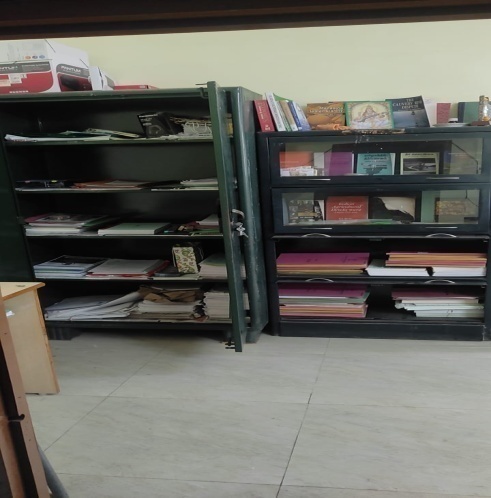
One small library and a computer is set up this year and it has to be developed further.
Vision & Mission
Vision The vision of the department of Economics consists of exploring the economic study and analysis, policy framing and implementation issues faced by the Indian economy along with the analysis of other economies in the world. To prepare students for acquiring applied knowledge of economics to enhance their employability and entrepreneurship. Make use of AI technology in all possible ways. Mission The mission of the Department of Economics consists of two interconnected components: imparting the highest quality instruction to our undergraduate and post graduate students and to train students in the methods and ideas of modern theoretical, applied economics and creating awareness to students for getting jobs by knowing the opportunities available in the technology based skill enhancement such AI technology. Programmes Offered Undergraduate Programmes
- B.A. Economics – I Year –2023-24 Regulations (B.A. Honors – 8 Semesters)
- B.A. Economics – II Year – 2023-24 Regulations (B.A. Honors – 8 Semesters)
- B.A. Economics – III Year - 2020 Regulations
- M.A. Economics – I Year – 2020 Regulations
- M.A. Economics – II Year – 2020 Regulations
- PO 1: Students will develop the powers of inquiry, critical analysis, logical thinking, and ability to apply theoretical knowledge to current issues of policy and practice in economics.
- PO 2: Students will be skilled in model building, testing economic models using advanced methods and sophisticated economic tools, analyzing, interpreting and formulating development policies.
- PO 3: Possess an ability to offer alternative solution on policy issues and demonstrate the ability to analyse, interpret and draw valid conclusions from quantitative and qualitative data.
- PO 4: Communicate effectively on specific economic issues and present complex information in a clear and concise manner.
- PO 5: Kindle the interest to use ICT in learning environment and nurture the spirit of leadership qualities and readiness to work and learn.
- PEO 1: Students will develop a thorough knowledge about the subject and its allied realms. They will have in-depth understanding of the theoretical and empirical constructs in the field of Economics.
- PEO 2: Students will build up the habit of critical thinking. They will develop an informal and analytical approach to learning and will be able to give his/her opinion supported by logical reasoning and problem solving skills.
- PEO 3: Students will be equipped with a set of tools of econometrics, which would help them to solve real-world problems.
- PEO 4: Students will develop a passion to be an independent lifelong learner by imbibing real-time changes in the socio-technological context, promoting continuous development and improvement of the knowledge and skills needed for employment and personal fulfillment.
- PEO 5: Students will be made conscious about the issues of environmental contexts and will be trained to promote values and attitudes that claim coexistence and sustainable living with reduced, minimal, or no harm upon ecosystems.
- PSO1: Have the Capability to demonstrate comprehensive knowledge and understanding on the basic concepts and theories that form a part of this programme.
- PSO2: Have the Capacity to analyse and evaluate the current events from an economic perspective.
- PSO3: Expand skills in practical application of economic theory.
- PSO 4: Possess an ability to offer alternative solution on policy issues.
- PSO 5: Demonstrate the ability to analyse, interpret and draw valid conclusions from quantitative and qualitative data.
- PSO 6: Communicate effectively on specific economic issues and present complex information in a clear and concise manner.
- PSO 7: Kindle the interest to use ICT in learning environment.
- PSO 8: Nurture the spirit of leadership qualities and readiness to work and learn.
- PSO 9: Boost the spirit of self confidence and inculcate the spirit of moral values.
- PSO10: Build strong foundation for pursuing continuous learning.