


About The Department
Department of BIOMEDICAL Engineering
About the Department
Department of Biomedical Engineering was established in the year 2006 with an intake of 60 students with the objective to produce well-groomedbiomedical engineers as skilled professionals in various domains of Biomedical Engineering.
They are ready to deploy in industrial projects upon graduation through outcome based education with activity-based learner-centric approaches blended with state-of-art technology tools which leads to innovation and entrepreneurship skills.
The department offers Undergraduate (UG), Post Graduate (PG), and Ph.D degree programs.
This interdisciplinary programme is a combination of engineering principles, medicine, and biological sciences specializations in the areas of Biomechanics, Bioinstrumentation & Biomaterial Engineering.
Department is involved in Teaching and Research in collaboration with St.Peter’s Medical College, Hosur, and with other Departments of SPIHER.
Department of Biomedical Engineering has collaboration with various industries, hospitals and research organizations to promote industry/hospital training and research based learning to the students.
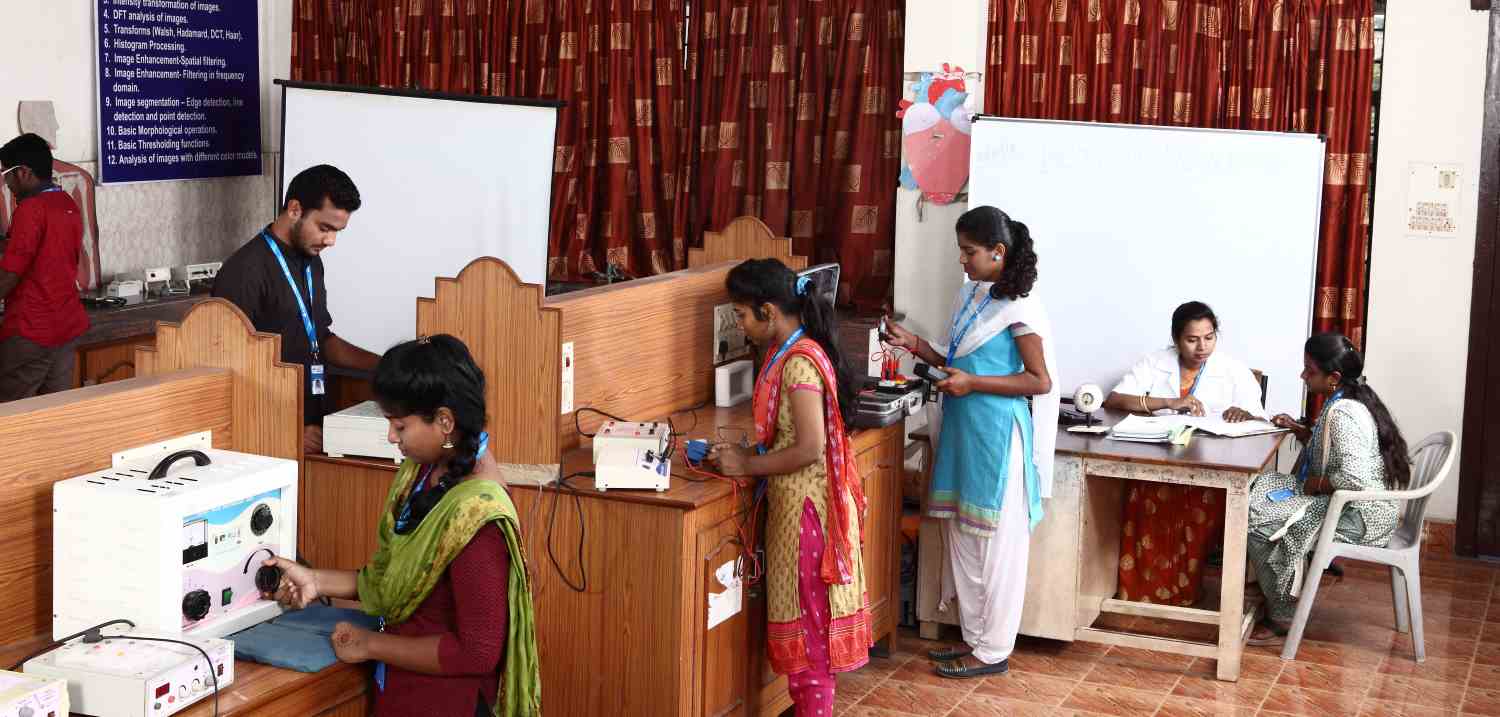
- The Department has well equipped laboratories, library, e-classroom and qualified staff members.
- Research in the department focuses on various disciplines: Image and Signal Processing, Biological Modelling and Simulations, programing of embedded systems, Simulations for Networking Systems in Medicine.
- The BME department develops students to meet the challenges in the industry by taking part in internships, industrial training, and industrial visits and motivate them to do innovative projects.
- Placements in the Biomedical Engineering Department are focused on companies dealing in Manufacture, Sales and Marketing of Medical Devices and providing Technical Support to the customers. A good number of students are also getting placed in Corporate Hospitals, IT/ITES companies, Education Management firms.
- Students are placed in GE Healthcare, Siemens Healthineers, Lifeline Hospitals, Biovision, etc
- Students have their start-ups in various fields of biomedical engineering such as equipment used during medical emergencies (Criticare), overall medical diagnosis and healthcare.
Head of the Department

Dr.Bobby N.D obtained her Bachelor of Engineering in Electronics and Communication,from University of Madras, India in 1993. She obtained her Master of Engineering in Applied Electronics from University of Madras in the year 2001. She then obtained her Ph.D.,From Electronics and Communication Engineering, for her research in modifying and designing add compare select unit of Viterbi decoder to minimize the power consumption in digital receiver circuits, from Jawaharlal Nehru Technological University, Hyderabad, in 2014. Currently she is employed as Professor and Head in Biomedical Engineering Department, St.Peter’s Institute of Higher Education and Research, Chennai. Her area of interest includes Medical Electronics, Biomedical Instrumentation, Sensors & Transducers and Digital Image Processing for biomedical applications. She is serving in the field of teaching for the past 23 years at various levels. She is Involved in establishing laboratories in Electronics and Communication and Biomedical Engineering departments. She has published more than 40 Research papers in the National/International Journals and 50 Research Papers in National/International Conferences.She has published 3 patents and got one patent grant in her name.She has organizedInternational &National Conferences, FDP, Workshop, Seminars, etc for both faculty and students. She guides and motivates the faculty and students to do innovations.
BOS Members
| S.No | Name | Designation | Member |
| 1 | Dr.Bobby ND | Professor & Head | Chairperson |
| 2 | Dr.K.Kantharaj | Professor | Internal Member |
| 3 | Dr.Ganesh | Professor | Internal Member |
| 4 | Dr.ChitraSudhakaran | Assistant Professor | Internal Member |
| 5 | Dr.Angelin Flashy | Assistant Professor | Internal Member |
| 6 | Mr.RameshHari Krishna | Assistant Professor | Internal Member |
| 7 | Ms.Praveena.G | Assistant Professor | Internal Member |
| 8 | Mr.Satish Kumar | Assistant Professor | Internal Member |
| 9 | Dr.K.Venkatraman | Technical Manager Biovision Medical Systems | External Member - Industry Expert |
| 10 | Dr.N.M.Masoodhubanu | Professor Department of Biomedical Engineering Veltech | External Member - Academic Expert |
| 11 | Ms B.Hemavathi | Research Assistant Nobotron Private Limited | Alumni |
B.E. – Biomedical Engineering
Department of Biomedical Engineering is recognized as a world leader in preparing students for careers in industry and business and for graduate education in engineering, medicine, and science. Biomedical engineering, or bioengineering, is the application of engineering principles to the fields of biology and health care. Biomedical engineers work with doctors, therapists and researchers to develop systems, equipment and devices in order to solve clinical problems. Biomedical engineering utilizes knowledge from traditional engineering disciplines to solve problems in living systems. The undergraduate program contains a set of ?core knowledge,? defined and taught by the faculty, that future biomedical engineers should possess.
Our students were exposed to various trainings in hospitals and companies. Various programmes like seminars, workshops were organized by the department to inculcate research in the young minds. Students were encouraged by giving seed money for the best ideas do their project.
CURRICULUM AND SYLLABUS
B.E. BIOMEDICAL ENGINEERING (REGULATION – 2020)
B.E. BIOMEDICAL ENGINEERING (REGULATION – 2023)
Ph.D – BioMedical Engineering
M.E. – Biomedical Engineering
Biomedical engineering is the application of principles and problem-solving techniques of engineering to biology and medicine. This is evident throughout healthcare, from diagnosis and analysis to treatment and recovery, and has entered the public conscience though the proliferation of implantable medical devices, such as pacemakers and artificial hips.
Biomedical engineering focuses on the advances that improve human health and health care at all levels. Biomedical engineering differs from other engineering disciplines that have an influence on human health in that biomedical engineers use and apply an intimate knowledge of modern biological principles in their engineering design process. There are many sub disciplines within biomedical engineering, including the design and development of active and passive medical devices, orthopaedic implants, medical imaging, biomedical signal processing, tissue and stem cell engineering, and clinical engineering.
CURRICULUM AND SYLLABUS (Regulation 2013, 2017 and 2018):
M.E. - Biomedical Engineering (REGULATIONS 2021)
RESEARCH AREAS:
- Biomaterials
- Biomechanics
- Biomedical Imaging
- Bioinstrumentation
- Biological Micro-electromechanical Systems (Bio-MEMS)
- Cellular Scale Bioengineering
- Neuro-Engineering
Ph.D. Bio Medical Engineering
Events
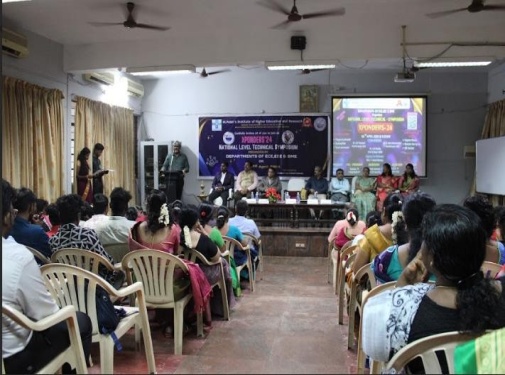
National Level Technical Symposium Xponders 24-03.04.2024
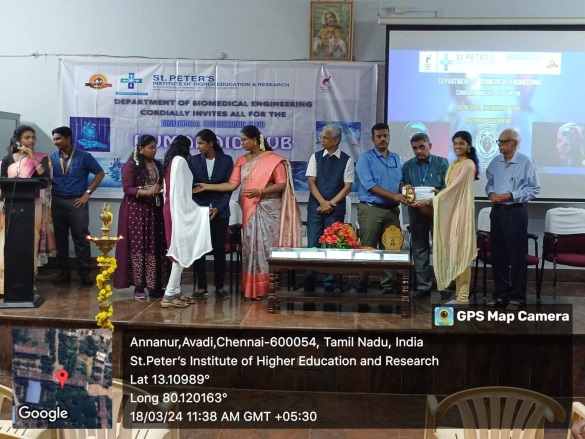
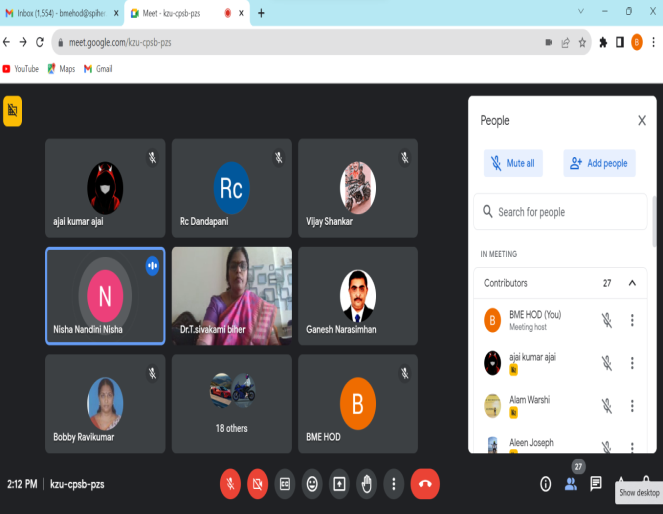
Inaugural of Biomedical club Humanoid Hub from 14-3-2024 to 18-3-2024

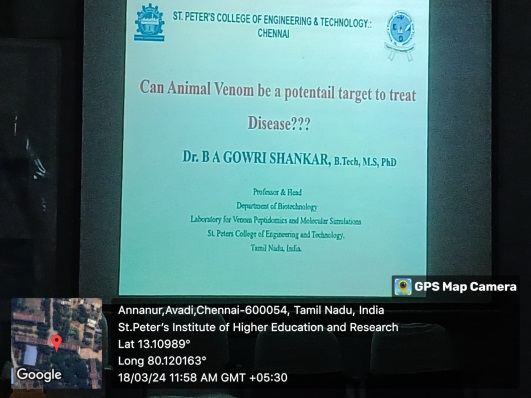
Guest Lecture on “Toxins a novel Therapeutic tool for diseases caused due to Chanellopathies” On 18-3- 24

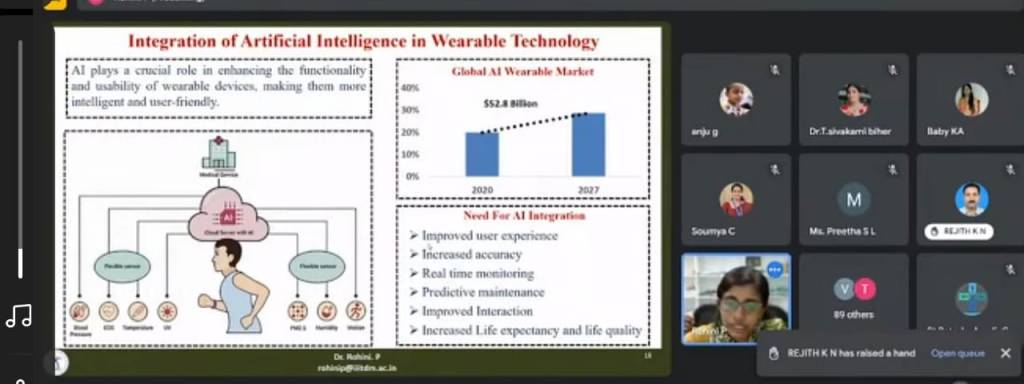
FDP – Recent Trends in Biomedical Application using AI from 29.01.2024 to 02.02.2024

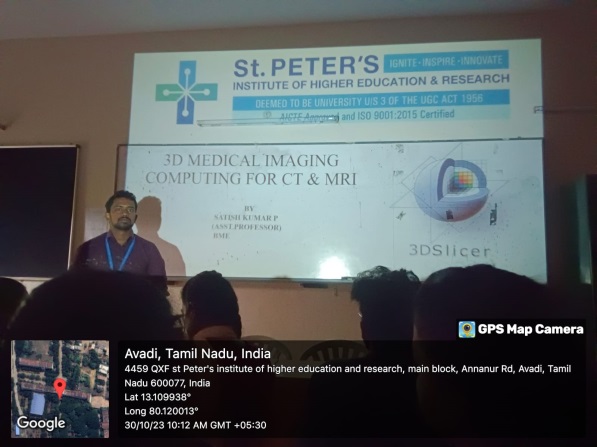
One day workshop on “3D Medical Imaging computing for CT & MRI” on 30/9/2024
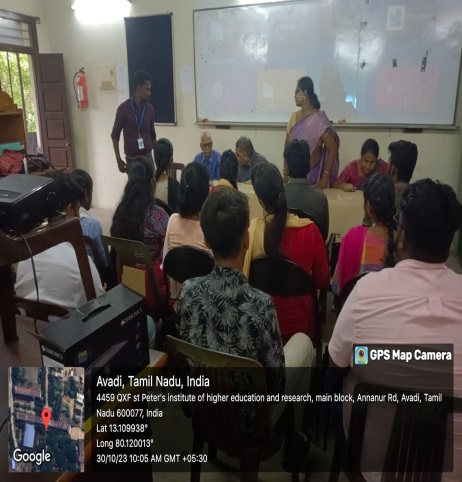
Industrial Visit to CSIR, CHENNAI On 26-9-2023


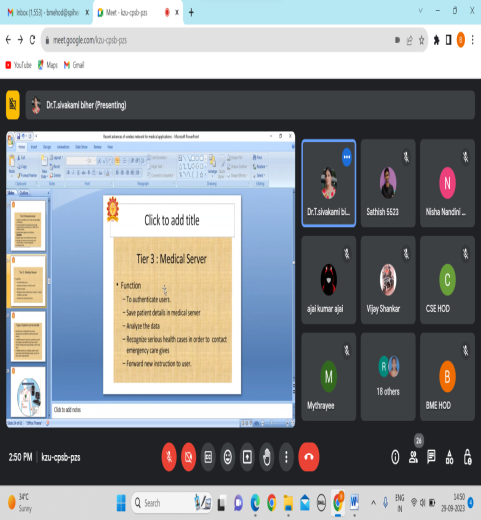
Guest Lecture on “Recent Advances of Wireless Networks for Medical Applications” 29th September-2023


Facilities
LABORATORIES
| LAB NAME | AVAILABLE AREA (sq.ft) |
|---|---|
| Biomedical Instrumentation Lab | 34X26 |
| Diagnostic and Therapeutic Equipment Lab | 34X26 |
| Human physiology Lab | 34X26 |
| Pathology and Microbiology Lab | 34X26 |
| Digital Image Processing Lab | 34X26 |
| Clinical Instrumentation Lab | 34X26 |
| Bio Signal Processing Lab | 34X26 |
Department Library Volumes:-
- 150 text books
- 5 Lab manuals
- 21 student project reports
- Question Banks
- Student project CDs
- Project kits
- NPTEL Lectures
Along with the central library of the university the Biomedical department has got another separate library, where various different subject books of Biomedical are placed. The dept Faculties, Staff and students can make use of this library

Vision & Mission
Vision
- To develop Health oriented Engineering technologies and to enhance and improve the health status of the Nation.
Mission
- To produce academically qualified research oriented and profession ally eminent Biomedical Engineers to serve the field of medicine with their Engineering skills.
- Apply knowledge about design in the development of enabling technologies for the improvement of human health.
- Promote Biomedical Engineering research with ethics in the development of novel and innovative technologies.
PROGRAM OUTCOMES (POS):
Engineering Graduates will be able to:
- PO1:Engineering knowledge: Apply the knowledge of mathematics, science, engineering fundamentals and an engineering specialization to the solution of complex engineering problems.
- PO2: Problem analysis: Identify, formulate, review research literature, and analyze complex engineering problems reaching substantiated conclusions using first principles of mathematics, natural sciences, and engineering sciences.
- PO3: Design/development of solutions: Design solutions for complex engineering problems and design system components or processes that meet the specified needs with appropriate consideration for the public health and safety,and the cultural, societal and environmental considerations.
- PO4: Conduct investigations of complex problems: Use research-based knowledge and research methods including design of experiments, analysis and interpretation of data, and synthesis of the information to provide valid conclusions.
- PO5: Modern tool usage: Create, select, and apply appropriate techniques, resources, and modern engineering and IT tools including prediction and modeling to complex engineering activities with an understanding of the limitations.
- PO6: The engineer and society: Apply reasoning informed by the contextual knowledge to assess societal, health, safety, legal and cultural issues and the consequent responsibilities relevant to the professional engineering practice.
- PO7: Environment and sustainability: Understand the impact of the professional engineering solutions in societal and environmental contexts, and demonstrate the knowledge of, and need for sustainable development.
- PO8: Ethics: Apply ethical principles and commit to professional ethics and responsibilities and norms of the engineering practice.
- PO9:Individualandteamwork:Functioneffectivelyasanindividual,andasamemberorleaderin diverse teams and in multidisciplinary settings.
- PO10: Communication: Communicate effectively on complex engineering activities with the engineering community and with society at large, such as, being able to comprehend and write effective reports and design documentation, make effective presentations, and give and receive clear instructions.
- PO11: Project management and finance: Demonstrate knowledge and understanding of the engineering and management principles and apply these to one’s as a member and leader in a team, to manage projects and in multidisciplinary environments.
- PO12: Life long learning: Recognize the need for and have the preparation and ability to engage in independent and life-long learning in the broadest context of technological change.
Program Educational Objectives (PEO)
- PEO1: Demonstrate their skills in solving challenges in their chosen field through the core foundation and knowledge acquired in biology, medicine and engineering.
- PEO2: Display leadership, make decisions with societal and ethical responsibilities, function and communicate effectively in multidisciplinary settings.
- PEO3: Recognize the need for sustaining and expanding their technical competence and engage in learning opportunities throughout their career and life.
Program Specific Outcomes (PSO)
- PSO1: To apply advanced technology for measurement and interpretation of biological data addressing the issues associated with the interface between living and non-living systems.
- PSO2: To utilize mathematics, software tools, science and engineering for accurate diagnosis and therapy.
- PSO3: To develop and improve information system in healthcare for automated and remote access.