Partnerships for the Goals
- Home
- Partnerships for the Goals
Partnerships for the Goals
Introduction
SDG 17, “Partnerships for the Goals,” emphasizes the importance of collaboration to achieve sustainable development worldwide. It recognizes that no single entity can tackle global challenges alone, and effective partnerships between governments, the private sector, civil society, and individuals are essential. This goal encourages the pooling of resources, knowledge, and expertise to accelerate progress toward all 17 Sustainable Development Goals (SDGs). By fostering inclusive and transparent partnerships, SDG 17 seeks to strengthen global cooperation, enhance capacity-building, and ensure that the benefits of sustainable development reach all corners of the world. Achieving SDG 17 is vital for creating a more sustainable and equitable future.
Read More
At St. Peter’s Institute of Higher Education and Research (SPIHER), we recognize the critical role that partnerships play in achieving the United Nations Sustainable Development Goals (SDGs). Specifically, SDG 17, which focuses on fostering collaboration to achieve global sustainability, aligns with our commitment to environmental responsibility. Through effective management of various waste streams, including solid waste, liquid waste, biomedical waste, and e-waste, SPIHER actively contributes to environmental sustainability. We have implemented advanced waste recycling systems to minimize waste and promote resource conservation, while engaging students, faculty, and local communities in these initiatives. By forging partnerships and promoting awareness, SPIHER is committed to a cleaner, greener future, driving change through collective efforts to achieve sustainable development.
Procedure followed in SPIHER for Waste Management
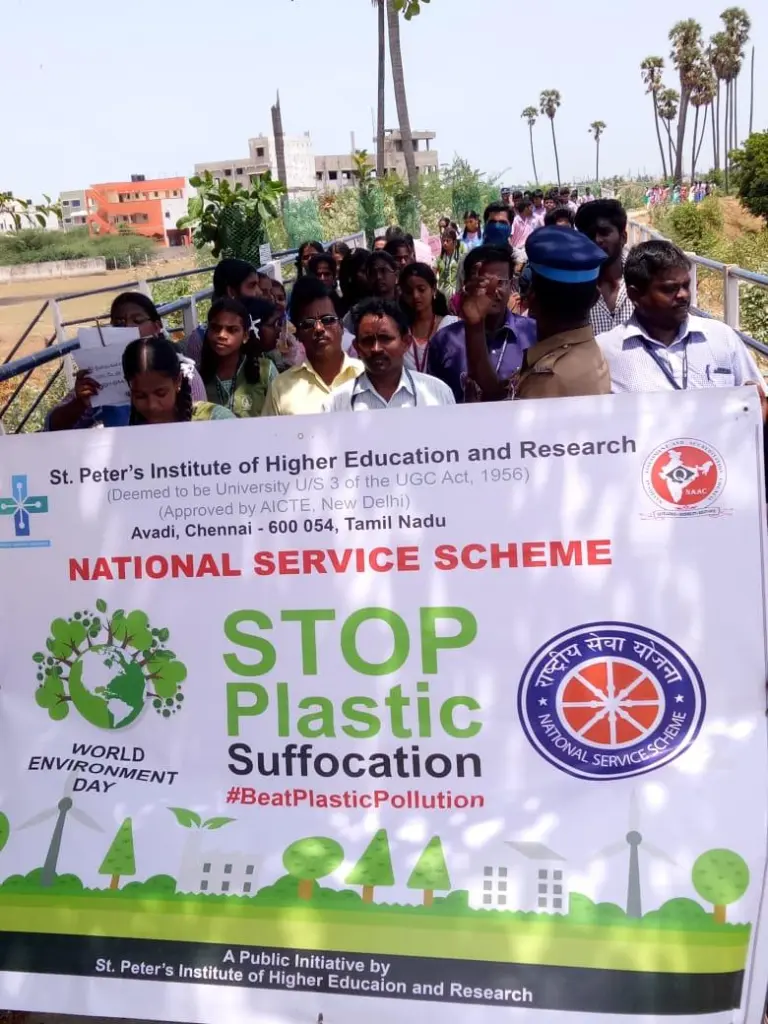
The institution is committed to maintaining an eco-friendly campus through effective waste management practices aimed at protecting the environment and enhancing safety. Central to this effort is the three R’s concept: Reduce, Reuse, and Recycle. Several initiatives have been undertaken to manage various types of waste, including solid, liquid, biomedical, chemical, and e-waste. Campus cleanliness is ensured through regular collection of solid waste from classrooms, laboratories, libraries, canteens, and hostels, supported by a dedicated maintenance staff. A Green Day is observed monthly, involving both faculty and students in cleaning the campus to raise awareness about cleanliness. Trash cans are strategically placed to separate wet and dry waste, promoting proper disposal. Water from RO plants is repurposed for gardening, while kitchen waste is processed in a biogas plant, with the resulting gas used for cooking. E-governance procedures have been implemented to minimize paper waste, such as internal communication circulars. Efforts to create a plastic-free campus include frequent awareness programs for faculty and students. Additionally, the institute operates a Sewage Treatment Plant to recycle wastewater, making it suitable for irrigation purposes, further contributing to sustainability efforts.
1. Solid Waste Management
At SPIHER, we have implemented a systematic waste management approach to ensure environmental sustainability on campus. Trash cans are strategically placed throughout the campus to segregate wet and dry waste, promoting proper waste disposal. In collaboration with external agencies, we have signed Memorandums of Understanding (MoUs) to ensure the safe periodic disposal of solid waste such as paper, glass, and metals. Additionally, biodegradable waste generated from the hostel is carefully segregated and processed in a biogas decomposer tank, where it undergoes fermentation to produce biogas, which is then used for cooking in the hostel. To ensure safe disposal of sanitary napkins, incinerators are installed in various ladies’ toilets and the hostel, providing a secure and hygienic solution for napkin waste disposal. These initiatives reflect SPIHER’s commitment to sustainable waste management practices.
2. LIQUID WASTE MANAGEMENT
SPIHER is committed to sustainable water and waste management practices, particularly in handling liquid waste. A sewage treatment plant with a capacity of 1 lakh liters has been installed to cater to the needs of the hostels, ensuring proper treatment and disposal of sewage. Additionally, septic tanks are provided for all campus buildings to manage sewage efficiently. Raw borewell water is sourced from the campus and fed into a 500-liter per hour RO plant, where it undergoes treatment, and the purified water is used for gardening across the campus. Recognizing the complexity of managing liquid waste, SPIHER has ensured that its sewage treatment facilities are regularly updated to effectively handle and dispose of liquid waste, maintaining environmental safety and sustainability.
3. BIOMEDICAL WASTE MANAGEMENT
At SPIHER, we prioritize safe and effective disposal of biomedical, microbiological, and biotechnological waste. An autoclave is employed for sterilizing used bacterial species, ensuring that petri plates contaminated with bacteria are decontaminated through sterilization at 120ºC for 20-30 minutes. The autoclave is located in a dedicated, isolated, and well-ventilated section of the Biotechnology and Microbiology laboratories to prevent any bacterial or viral contamination from spreading in the experimental setup. Additionally, an incinerator is used for the safe disposal of biological waste such as cotton and bandages, ensuring that all waste is handled in accordance with health and safety protocols.
4. E-WASTE MANAGEMENT
E-wastes are collected and responsibly handed over to external agencies for recycling the materials, ensuring that harmful components are properly processed. To further promote sustainable practices, awareness programs are regularly organized within the institution. These programs aim to educate students and staff about E-waste management techniques, highlighting the importance of recycling and reducing electronic waste in an environmentally friendly manner.
5.WASTE RECYCLING SYSTEM
The fundamental principle of SPIHER’s waste recycling system is the implementation of the 3R’s—Reduce, Reuse, and Recycle. This approach guides the institution’s commitment to sustainability. Treated water from the Sewage Treatment Plant (STP) and the RO plant is repurposed for gardening, reducing water wastage. Additionally, food waste and plant waste are processed in the biogas plant, where fermentation produces biogas, which is then used as a fuel source in the kitchen. This holistic approach to waste management not only minimizes environmental impact but also contributes to resource conservation on campus.
6. WASTE RECYCLING SYSTEM
The fundamental principle of SPIHER’s waste recycling system is the implementation of the 3R’s—Reduce, Reuse, and Recycle. This approach guides the institution’s commitment to sustainability. Treated water from the Sewage Treatment Plant (STP) and the RO plant is repurposed for gardening, reducing water wastage. Additionally, food waste and plant waste are processed in the biogas plant, where fermentation produces biogas, which is then used as a fuel source in the kitchen. This holistic approach to waste management not only minimizes environmental impact but also contributes to resource conservation on campus.
4. E-WASTE MANAGEMENT