Computer Applications
- Home
- Academics
About Department of
Computer Applications
The Department of Computer Science & Applications was established in 1995, and strives hard to develop top class professionals, who will be responsible in providing their hands to support the constant booming of the Information Industry era.
The department works as a team of dedicated faculty who has knowledge in the latest fields of technology / development in the global scenario. The Department has conducted successfully several National Level Seminars, Conferences, Staff Development Programmes, Faculty Development Programmes and Workshops every year. Also, the Faculty members are encouraged to attend specialized training programme and pursuing higher studies.
Read More
The department has a well-furnished lab with intranet and 24 hours 1 Gbps Internet facility. The department is very meticulous in conducting Open House Meetings for the students in which the faculty members, Directors and Dean participate. This is an open forum where the students are allowed to air their impressions, in the hardware and software areas. Students and faculty participate enthusiastically and contribute towards bringing effective solutions to the problems. This continuous monitoring of the teaching-learning process has improved the performance to a considerably high level which will help the students to get ready to face the placement and employment arena.
Faculty counsellors are appointed for every 15-20 students. They size up the strengths and weaknesses of the students and provide individual counselling and help. They not only provide guidance counselling in subjects but also in personal problems.
(2023-2024)
Vision
To develop students to achieve academic excellence in all spheres of Computer Applications with emphasis on continual improvement leading to Research.
Mission
M1: To impart strong foundational and advanced knowledge in Computer Applications for academic and professional excellence.
M2: To enhance analytical, problem-solving, communication, and interpersonal skills for securing meaningful careers in IT and related domains.
M3: To provide quality education, practical exposure, and training in emerging software technologies to produce skilled professionals capable of facing future challenges.
M4: To motivate students to pursue higher studies, research, and entrepreneurship while fostering innovation and sustainable solutions for the benefit of society.
Programmes
Computer Applications
POs,PSOs and PEOs
Programme Educational Objectives (PEOs)
PEO 1: To prepare graduates to be successful professionals in industry, academia and in entrepreneurial pursuit.
PEO 2: To prepare Graduates to excel as socially committed individual having high ethical values and empathy for the needs of society
PEO 3: To prepare graduates to achieve peer-recognition, as an individual and as a team player, through demonstration of good analytical, design, implementation and interpersonal skills.
PEO 4: To prepare graduates to contribute to society as broadly educated, expressive, ethical and responsible citizens with proven expertise.
Programme Outcomes (POs)
PO 1: Complex problem-solving: The graduates should be able to demonstrate the capability to solve different kinds of problems in familiar and non-familiar contexts and apply the learning to real-life situations
PO 2: Critical thinking: The graduates should be able to demonstrate the capability to apply analytical thought to analyze and synthesize data from a variety of sources and draw valid conclusions.
PO 3: Creativity: The graduates should be able to demonstrate the ability to create, perform, or think ‘out of the Box’ in different and diverse ways to complex problems by adopting innovative, imaginative, lateral thinking, interpersonal skills and emotional intelligence.
PO 4: Communication Skills: The graduates should be able to demonstrate the skills that enable them to listen, read texts and research papers, present complex information in a clear and concise technical language related to a field of learning.
PO 5: Analytical reasoning/thinking: The graduates should be able to demonstrate the capability to evaluate the reliability, identify logical flaws, analyse and synthesize data from a variety of sources to acquire valid conclusions.
PO 6: Research-related skills: Graduates should be able to demonstrate a keen sense of observation and inquiry, the ability to ask relevant questions, design research proposals, define problems, formulate and test hypotheses using quantitative and qualitative data, interpret results to infer cause-and-effect relationships, develop suitable methodologies and data collection tools, apply statistical and analytical techniques appropriately, conduct and report research or experiments effectively, and understand and practice research ethics across disciplines and funding contexts
PO 7: Coordinating/collaborating with others: The graduates should be able to act together as a group or a team in the interests of a common cause and work efficiently as a member with diverse teams
PO 8: Leadership readiness/qualities: The graduates should be able to formulate an inspiring vision and building a team to achieve by setting direction, motivating and inspiring team members using management skills.
PO 9: Lifelong Learning & Technology skills:
Graduates should be able to continuously acquire new knowledge for lifelong personal and professional growth, self-directed goals, adapting to Industrial Revolution to access, evaluate, and utilize relevant information sources and software for data analysis by using ICT.
PO 10: Multicultural competence and inclusive spirit:
The graduates should be able to demonstrate cultural awareness, global perspective, respectful engagement in diverse settings, and the ability to lead inclusive teams, show gender sensitivity and empathy toward the differently-abled and those with learning disabilities.
PO 11: Value inculcation:
Graduates should possess the knowledge and attitude to uphold constitutional, humanistic, and practice responsible global citizenship, maintain integrity, ethical conduct in work, respect intellectual property to actively contribute to environmental sustainability and social responsibility.
PO 12: Autonomy, responsibility, and accountability:
The graduates should be able to demonstrate the ability to apply knowledge and skills independently, manage projects from start to finish, and demonstrate responsibility and accountability in professional and learning contexts, including ensuring workplace safety and security.
PO 13: Environmental awareness & Community engagement and service:
The graduates should be able to apply the knowledge, skills, attitudes, and values necessary to address environmental degradation, climate change, and pollution, while promoting effective waste management, biodiversity and sustainable development activities for promoting the well-being of society.

Programme Specific Outcomes(PSOs)
PSO 1: To impart knowledge required for planning, designing and building Complex Application Software System
PSO 2: To develop programming skills, networking skills, learn applications, packages, programming languages and modern techniques of IT
PSO 3: To be able to employ modern computer languages and applications for their successful career, to create platforms to become an entrepreneur and a relish for higher studies.
Faculty Members
| Faculty Name | Designation | Qualification |
|---|---|---|
| Dr. R. Latha | Professor & Head | M.Sc., B.Ed., M.C.A, M.E., M.Phil., Ph.D. |
| Dr. D. Kavitha | Professor | M.C.A., M.Phil., Ph.D. |
| Dr. R. Subhashni | Professor | M.C.A., M.Phil., B.Ed., Ph.D. |
| Mr. N. Jagadeesh | Assistant Professor | M.C.A., M.Phil., (Ph.D.) |
| Ms. R. Vijayalakshmi | Assistant Professor | M.C.A., M.Phil., (Ph.D.) |
| Ms. S. Rajakumari | Assistant Professor | M.C.A., M.Phil., |
| Ms. R. Vinotha | Assistant Professor | M.C.A., M.Phil., (Ph.D.) |
| Ms. K. Komathi | Assistant Professor | M.C.A., (Ph.D.) |
| Ms. N. Priyanka | Assistant Professor | M.Sc., |
| Ms. R. Vasanthi | Assistant Professor | M.C.A. B.Ed., NET (Ph.D.) |
| Ms. D. A. Sharonu Rani | Assistant Professor | M.C.A., B.Ed.,(Ph.D.) |
| Ms. R. Dheepa | Assistant Professor | M.C.A., M.E. |
| Ms. I. Nancy | Assistant Professor | M.C.A. |
| Ms. K. Nandhini | Assistant Professor | M.C.A. |
| Mr. K. Rajkumar | Assistant Professor | M.Sc.,(IT) |
| Ms. K.E. Anandhi | Assistant Professor | M.C.A. |
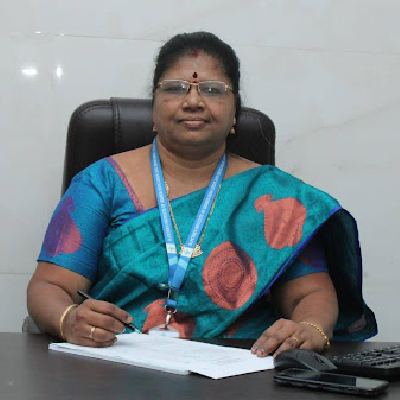
Dr. R. Latha
Prof & Head
M.Sc., B.Ed., M.C.A, M.E., M.Phil., Ph.D.
Dr. D. Kavitha
Prof
M.C.A., M.Phil., Ph.D.
Dr. R. Subhashni
Associate Prof
M.C.A., M.Phil., B.Ed., Ph.D.
Mr. N. Jagadeesh
Asst. Prof.
M.C.A., M.Phil., (Ph.D.)
Ms. R. Vijayalakshmi
Asst. Prof.
M.C.A., M.Phil., (Ph.D.)
Ms. S. Rajakumari
Asst. Prof.
M.C.A., M.Phil.,
Ms. R. Vinotha
Asst. Prof.
M.C.A., M.Phil., (Ph.D.)
Ms. K. Komathi
Asst. Prof.
M.C.A., (Ph.D.)
Ms. N. Priyanka
Asst. Prof.
M.Sc
Ms. R. Vasanthi
Asst. Prof.
M.C.A. B.Ed., NET (Ph.D.)
Ms. D. A. Sharonu Rani
Asst. Prof.
M.C.A., B.Ed.,(Ph.D.)
Ms. R. Dheepa
Asst. Prof.
M.C.A., M.E.
Ms. I. Nancy
Asst. Prof.
M.C.A.
Ms. K. Nandhini
Asst. Prof.
M.C.A.
Mr. K. Rajkumar
Asst. Prof
M.Sc.,(IT)
Ms. K.E. Anandhi
Asst. Prof
M.C.A.
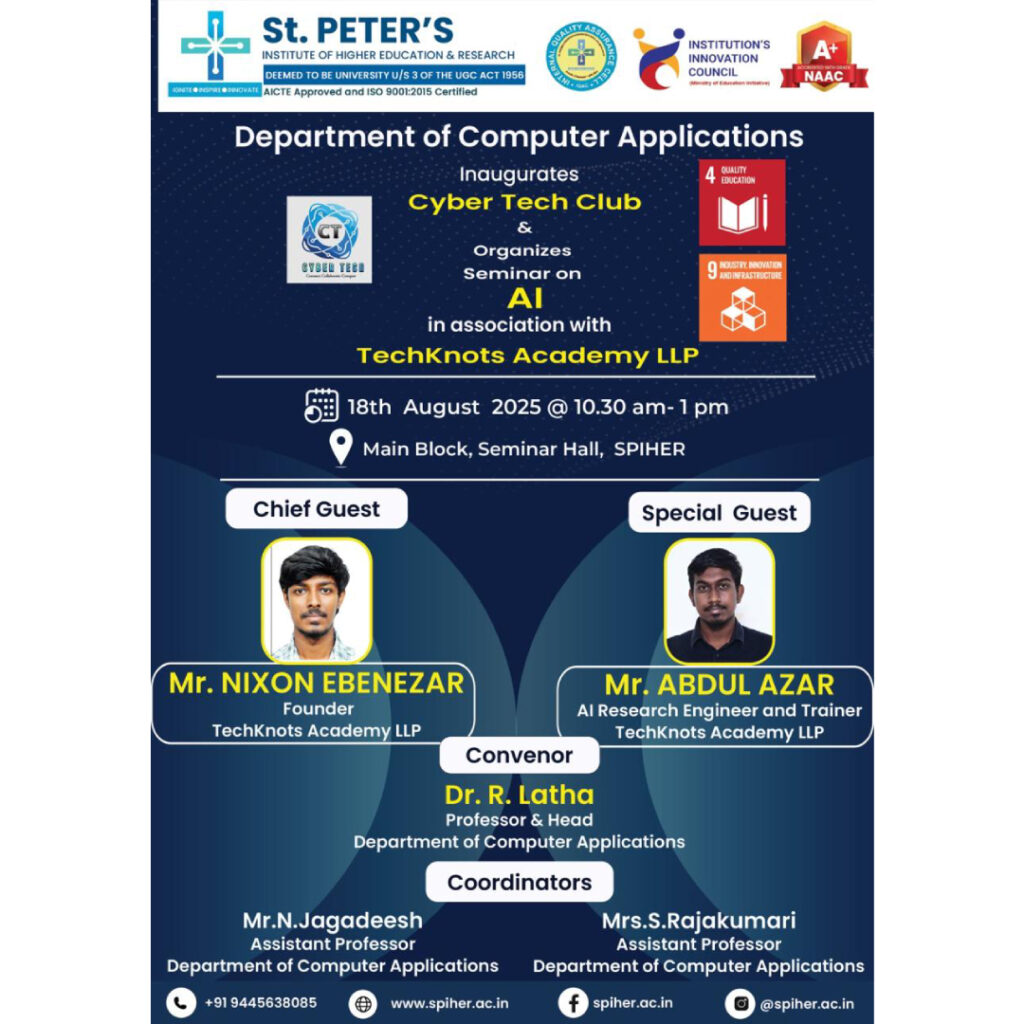
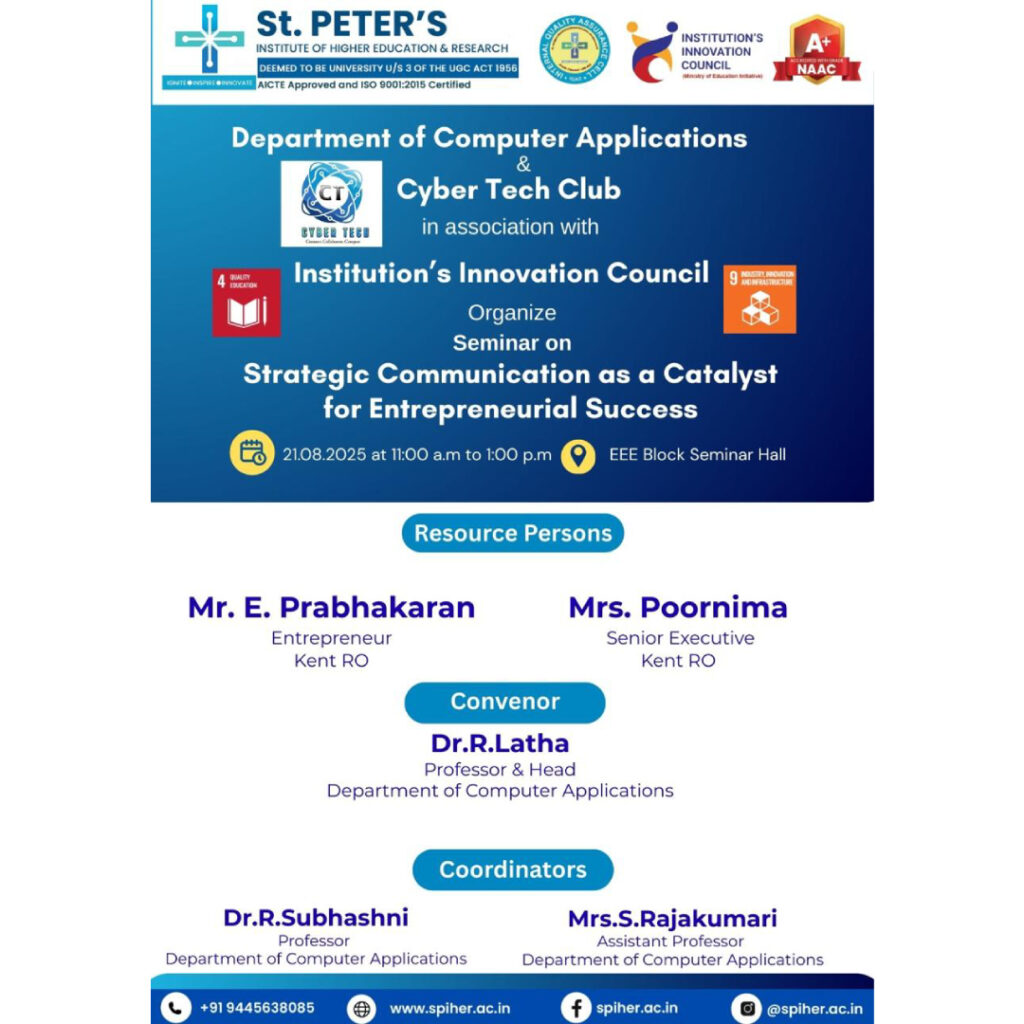
News & Events
Highest Package